

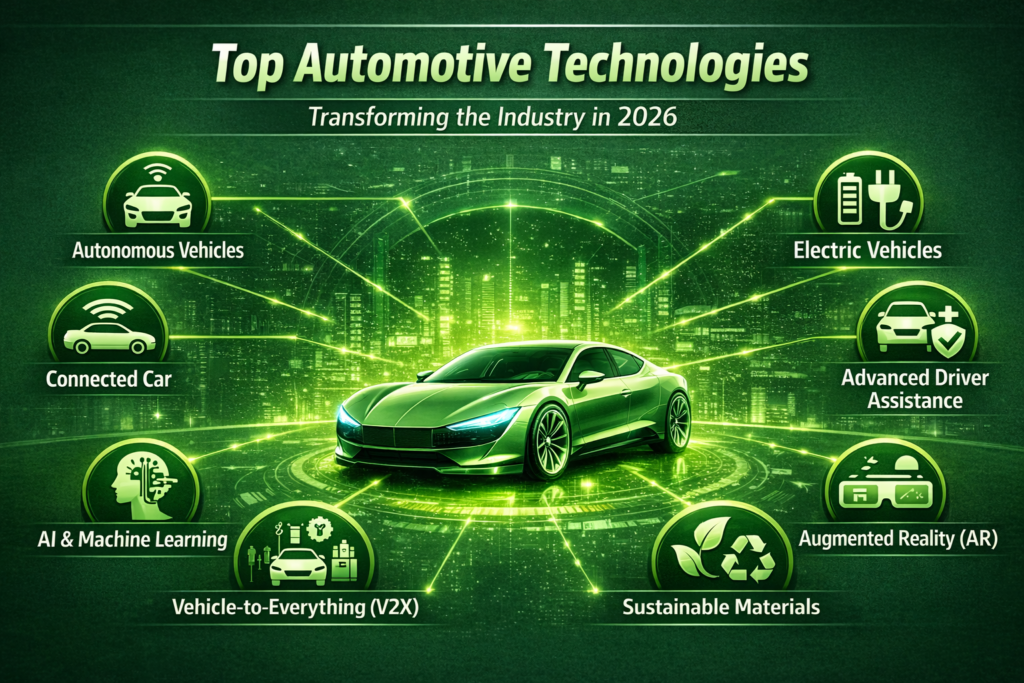
The automotive industry is undergoing one of the most rapid transformations in history. From connected electric vehicles to autonomous driving and AI-powered manufacturing, the future of mobility is being shaped today. In 2026, automotive innovation isn’t just about faster cars or sleeker designs – it’s about smart, sustainable, safe, and user-centric technologies that redefine how we travel, work, and live.
At AutoTech360, we closely track emerging automotive software, mobility platforms, and intelligent vehicle systems shaping the future.
In this comprehensive blog, we’ll explore the most impactful automotive technologies dominating 2026, why they matter, and how they’re reshaping the future of transportation.
Table of Contents
Toggle1. Electric Vehicles (EVs): Powering the Future
Electric vehicles are no longer a trend – they’re a revolution.
EV Growth and Market Expansion
Electric cars continue to surge in popularity as governments worldwide tighten emission regulations. Today’s EVs offer:
-
Longer range per charge
-
Faster charging speeds
-
Lower maintenance costs
-
Zero tailpipe emissions
By 2026, EVs move from early adoption to mainstream mobility, supported by intelligent automotive platforms like those discussed on AutoTech360’s automotive technology insights.
Key EV technologies transforming the industry:
-
Solid-state batteries for higher energy density
-
Fast charging networks with 15-minute top-offs
-
Vehicle-to-Grid (V2G) integration for smart energy management
2. Autonomous Driving: From Assisted to Fully Self-Driving
Autonomous driving continues to be the most talked-about automotive innovation.
Levels of Autonomy
The industry standard classifies autonomy into six levels (0-5):
- Level 2–3: Advanced driver assistance (ADAS)
- Level 4: High automation in controlled settings
- Level 5: Fully autonomous in all conditions
While Level 5 remains a future milestone, Level 4 systems are rolling out in controlled environments, especially in ride-hailing and logistics.
Key Autonomous Tech Advancements in 2026
- Multi-sensor fusion (LiDAR + Radar + Camera)
- AI-driven perception systems
- Real-time mapping and localization
- Edge computing for safer decision-making
Autonomous cars are not just about hands-off driving – they promise safer roads, optimized traffic, and new mobility services.
3. Connected Vehicles: Revolutionizing Mobility
Today’s cars are more connected than ever before.
What is a Connected Vehicle?
A connected vehicle uses internet-enabled technologies to communicate with:
- Other vehicles (V2V)
- Road infrastructure (V2I)
- Pedestrians (V2P)
- Cloud services
Together, this ecosystem is known as V2X technology (Vehicle-to-Everything).
Benefits of Connectivity
- Real-time traffic updates
- Over-the-air (OTA) software upgrades
- Remote diagnostics and predictive maintenance
- Enhanced safety through data sharing
In 2026, connected vehicles fuel smart cities, adaptive transportation systems, and personalized driver experiences.
4. Next-Gen Battery Technologies
Battery advancements drive the future of electrification.
Why Batteries Matter
Battery tech determines:
- How far an EV can travel
- How quickly it can charge
- Lifecycle cost and sustainability
Breakthroughs in 2026
1. Solid-State Batteries
- Higher energy density vs. lithium-ion
- Safer (non-flammable)
- Longer life cycles
2. Lithium-Sulfur Batteries
- Potential for lighter weight
- Higher theoretical capacity
Fast Charging Innovations
- 800+ volt architecture
- Ultra-rapid charging stations
These technologies make EVs more practical, affordable, and appealing – accelerating mass adoption.
5. Artificial Intelligence (AI) in Automotive
AI isn’t just in self-driving – it’s everywhere.
How AI Transforms Automotive
From design to production to driving experience:
- Predictive maintenance
- Driver behavior analytics
- Quality control in manufacturing
- AI-powered infotainment
AI + Automotive Use Cases
- Detecting component defects on production lines
- Real-time risk assessment while driving
- Personalizing in-car experiences based on user preferences
AI is the “brain” that enables smarter, safer, more intuitive vehicles.
6. Advanced Driver Assistance Systems (ADAS)
While full autonomy is still emerging, ADAS technologies are mainstream in 2026.
Core ADAS Features
- Adaptive Cruise Control
- Lane Keeping Assist
- Automatic Emergency Braking
- Blind Spot Detection
These systems reduce accidents and add convenience for drivers.
New ADAS Innovations
- Predictive hazard detection
- Driver fatigue monitoring
- Night-vision assistance
ADAS is the stepping stone between manual driving and full autonomy.
7. Automotive Infotainment & UX
Vehicles are turning into mobile entertainment hubs.
Next-Level In-Car Experience
- Augmented Reality (AR) dashboards
- Voice-activated controls
- Personalized music, navigation, and settings
- Integration with smart devices and wearables
Manufacturers are fighting for best-in-class user experience, turning vehicle cabins into smart, engaging spaces.
8. Smart Infrastructure & Mobility Ecosystems
Cars don’t operate in a vacuum – they rely on intelligent infrastructure.
Smart Roads and Cities
- Sensors embedded in roadways
- Intelligent traffic management
- EV charging infrastructure
- Real-time traffic prediction
Integrated Mobility Services
- Ride-sharing platforms with EV/autonomous fleets
- Micro-mobility connections (e-scooters, bikes)
- Multi-modal journey planning
The focus is shifting toward mobility as a service (MaaS) rather than just selling vehicles.
9. Safety Tech Beyond ADAS
Safety continues to evolve beyond standard driver assistance systems.
Next-Gen Safety Innovations
- Biometric driver authentication
- Predictive crash avoidance systems
- Second-generation airbags and smart restraints
- AI-based emergency response alerts
Safety isn’t just about avoiding crashes – it’s about anticipating them before they happen.
10. Circular Economy & Sustainable Manufacturing
Environmental responsibility isn’t just about emissions – it’s about the whole lifecycle.
Sustainable Automotive Practices
- Recycled materials in vehicle parts
- Closed-loop manufacturing systems
- Carbon-neutral production plants
- Battery recycling and second-life use
Manufacturers are adopting green supply chains and eco-design principles to reduce environmental footprint.
11. 3D Printing & Advanced Manufacturing
Manufacturing processes in 2026 are smarter, faster, and more flexible.
Where 3D Printing Shines
- Custom components on demand
- Lightweight structures
- Reduced waste
- Faster prototyping
Additive Manufacturing Benefits
- Lower production costs
- Shorter development cycles
- Customization at scale
3D printing is transforming how vehicles are made – from concept models to fully functional parts.
12. Cybersecurity for Connected Vehicles
Connected cars mean new security threats – and new defenses.
Why Cybersecurity Matters
Cars today are essentially computers on wheels connected to networks, data services, and other vehicles. This creates vulnerabilities that must be protected.
Key Automotive Cybersecurity Measures
- Encrypted communication protocols
- Secure OTA updates
- Firewalls and intrusion detection
- AI-powered threat monitoring
Cybersecurity is now a core part of automotive engineering.
13. Telematics and Fleet Management
Data-driven fleet operations are becoming the norm.
Telematics Use Cases
-
Real-time tracking
-
Fuel efficiency optimization
-
Predictive maintenance
-
Driver performance analytics
Fleet intelligence is a growing focus in automotive software platforms featured on AutoTech360
14. Hydrogen Fuel Cell Vehicles (HFCVs)
While EVs dominate, hydrogen fuel cells are gaining attention – especially for heavy-duty transport.
What Are HFCVs?
Hydrogen fuel cell vehicles convert hydrogen into electricity with water as the only emission.
Key Benefits
- Fast refueling
- Long driving range
- Great for trucks, buses, and industrial vehicles
Hydrogen is an alternative clean fuel technology complementing battery EVs.
15. Subscription & Shared Mobility Platforms
Ownership models are evolving rapidly.
From Ownership to Access
People are choosing:
- Subscription-based car services
- Car sharing
- On-demand rentals
These models use smart platforms, connected vehicles, and real-time data to offer flexible mobility.
Conclusion: The Road Ahead
The automotive landscape in 2026 is rich with innovation. Technologies like electric powertrains, autonomous driving, connected vehicles, AI systems, and next-gen safety tech are redefining how we move and interact with vehicles.
What drives this evolution isn’t just engineering ingenuity – it’s consumer demand for safety, sustainability, convenience, and connectivity. As these technologies mature, we’ll see cars that are:
- Smarter
- Safer
- Greener
- More personalized
The automotive industry is no longer just about transportation – it’s about transformative mobility experiences.