

The automotive industry is experiencing a significant shift toward digital innovation.
Today’s car buyers are more knowledgeable, more connected, and have higher expectations for tailored experiences. Traditional sales approaches are no longer sufficient to remain competitive. This is where AI in the automotive sector is making a major difference.
From more effective customer engagement to improved sales predictions, artificial intelligence and machine learning are assisting dealerships in working more efficiently, making more sales, and offering better customer satisfaction.
This article looks at how machine learning for dealerships and automotive CRM AI are transforming car buying, marketing, and service processes.
The Digital Change in Car Dealerships
Modern car buyers often begin their search online.
They look up vehicle models, read reviews, check prices, and even apply for loans before visiting a dealership. Dealerships that use AI-based tools can monitor these online activities and react in real time.
Rather than waiting for walk-in customers, dealerships are now reaching out to potential buyers using AI-powered chatbots, custom email campaigns, and smart recommendation systems.
This change is not simply about using technology – it’s about making better decisions and delivering enhanced customer experiences.
What Is AI in Automotive?
AI in the automotive industry involves using artificial intelligence in various parts of the business, such as sales, marketing, customer service, inventory control, and post-purchase support.
While AI is often linked with autonomous vehicles, its influence on dealership operations is just as impactful.
Important uses include:
- Using predictive analytics for sales forecasts
- Automating customer communication
- Setting intelligent lead priorities
- Creating personalized marketing efforts
- Managing smart inventory systems
When integrated with machine learning algorithms, these systems keep improving by examining past data and customer interactions.
Machine Learning for Dealerships: Smarter Sales & Marketing

One of the most influential technologies in the automotive industry is machine learning for dealerships.
These models examine large amounts of customer data to find trends, predict actions, and suggest strategies.
1. Predictive Lead Scoring
Not all leads are the same.
Some customers are just looking, while others are ready to make a purchase. Machine learning algorithms assess customer actions like website visits, vehicle searches, financing requests, and past interactions to give a lead score.
Sales teams can focus on leads that are most likely to convert, saving time on less promising opportunities and improving sales outcomes.
2. Personalized Vehicle Suggestions
AI systems look at customer preferences, such as budget, vehicle type, brand loyalty, and search history.
Based on this information, they recommend cars that best fit the buyer’s needs.
This type of personalization helps build trust and improves the overall customer experience.
3. Adaptive Pricing Optimization
Pricing strategies can be fine-tuned using real-time market data.
Machine learning models consider elements like competitor prices, local demand, seasonal trends, and vehicle stock to suggest prices that are both profitable and appealing to buyers.
Automotive CRM AI: Enhancing Customer Relationships
Customer Relationship Management (CRM) systems have always played an important role in dealerships.
However, conventional CRMs are limited to storing customer details. With automotive CRM AI, dealerships can take advantage of advanced automation and predictive analysis.
1. Smart Customer Grouping
AI-powered CRM systems automatically categorize customers based on purchasing habits, service history, demographics, and engagement levels.
This enables dealerships to run focused marketing efforts instead of broad promotions.
For instance:
– Customers whose lease is about to end can get upgrade offers
– Customers who have used service can receive maintenance alerts
– Previous buyers can be approached for referrals
2. Automated Follow-Ups
AI can plan and send automated messages through email, SMS, or WhatsApp.
These messages are triggered by customer actions such as:
– Test drive requests
– Abandoned financing applications
– Service appointment reminders
Automation ensures no sales opportunity is overlooked.
3. Predictive Customer Retention
By studying service frequency and customer feedback, AI can identify which customers are likely to switch to competitors.
Dealerships can then offer incentives or personal support to keep them loyal.
AI Chatbots and Virtual Assistants
AI chatbots are now a common feature on dealership websites.
These virtual helpers can:
– Provide information on vehicle availability
– Share details about financing
– Book test drives
– Schedule service appointments
– Collect customer information for follow-up
Unlike human representatives, AI chatbots are available around the clock and respond instantly to customer inquiries, leading to better customer satisfaction.
Advanced chatbots also use natural language processing (NLP) to understand what customers mean and offer more natural, human-like conversations.
Smarter Inventory Management with AI
Inventory control remains one of the most complex operational challenges for car dealerships. Holding too many vehicles ties up capital and increases storage costs, while insufficient stock results in missed sales and dissatisfied customers.
AI in automotive inventory management is transforming how dealerships balance supply and demand. Instead of relying solely on past experience or manual forecasting, dealerships now use intelligent systems powered by machine learning for dealerships to make precise inventory decisions.
AI helps dealerships:
Identify high-demand vehicle models
Detect seasonal buying patterns
Adjust stock levels dynamically
Minimize aging or unsold inventory
By analyzing historical sales records, regional buying behaviors, online search trends, and market conditions, machine learning algorithms can predict which vehicles are likely to sell faster in specific locations. This ensures smarter purchasing decisions and healthier cash flow.
AI-Powered Marketing Campaigns for Automotive Growth
Automotive marketing has evolved dramatically from traditional newspaper ads and billboards to data-driven digital campaigns. With AI in automotive marketing, dealerships can target the right customer at the right time with the right message.
AI-powered automotive CRM AI systems evaluate customer behavior, browsing history, purchase intent, and engagement patterns to create highly personalized campaigns.
Key Advantages of AI-Driven Marketing
Personalized email campaigns tailored to individual interests
Automated digital ad targeting
Smart budget allocation for higher ROI
Real-time campaign performance tracking
Continuous A/B testing optimization
Instead of sending the same promotional message to every prospect, AI allows dealerships to segment audiences intelligently.
For example, a customer researching SUVs for family use will receive offers focused on safety features and space. Meanwhile, a young professional browsing compact cars may receive promotions highlighting fuel efficiency and smart technology features.
This level of personalization significantly increases engagement and lead conversion rates.
Enhancing the Test Drive Experience with AI
The test drive often determines whether a buyer moves forward with a purchase. AI systems can enhance this critical stage by preparing a personalized and seamless experience.
Using data from previous interactions, automotive CRM AI platforms help dealerships:
Pre-configure vehicle settings based on buyer preferences
Provide interactive virtual vehicle walkthroughs
Suggest relevant accessories or add-ons
Offer AI-assisted feature demonstrations
Some dealerships are also integrating augmented reality and virtual experiences, allowing customers to explore car features digitally before stepping into the showroom. This not only saves time but also builds excitement and confidence in the buying decision.
AI in Financing and Risk Assessment
Financing is a key factor in automotive sales, and speed plays a major role in closing deals. Machine learning for dealerships improves credit evaluation and reduces approval times significantly.
AI-powered systems can:
Instantly assess credit profiles
Identify potential fraud risks
Recommend tailored financing options
Suggest suitable insurance plans
By automating financial risk assessment, dealerships can provide quicker approvals, transparent financing options, and improved customer satisfaction. Faster processing also increases the likelihood of immediate deal closure.
Optimizing the Service Department with AI
The service department is a major contributor to dealership profitability. AI-driven service management solutions streamline operations and maximize revenue opportunities.
Predictive Maintenance
By analyzing historical repair records and vehicle usage patterns, AI predicts when a customer is likely to require servicing. Automated reminders encourage timely bookings, increasing workshop utilization.
Intelligent Technician Scheduling
Machine learning optimizes technician assignments based on expertise, workload, and repair complexity. This reduces waiting times and improves productivity.
Spare Parts Inventory Forecasting
AI systems forecast demand for spare parts, helping dealerships avoid shortages while minimizing overstock. This ensures faster repairs and improved customer satisfaction.
Data-Driven Decision Making in Automotive
One of the most powerful benefits of AI in automotive is real-time business intelligence. Modern dealerships use AI dashboards that provide instant insights across departments.
These dashboards track:
Sales performance metrics
Marketing return on investment (ROI)
Customer acquisition costs
Inventory turnover rates
Service department efficiency
Instead of depending on assumptions, dealership managers can rely on accurate, data-backed insights. This enables strategic planning, smarter budgeting, and continuous improvement.
Elevating Customer Experience Through AI
Today’s car buyers expect speed, transparency, and personalization. AI enables dealerships to meet and exceed these expectations.
AI improves customer experience by:
Delivering instant responses through intelligent chatbots
Offering personalized vehicle recommendations
Providing real-time financing estimates
Simplifying appointment scheduling
Maintaining consistent communication across channels
When customers receive timely and relevant interactions, they are more likely to trust the dealership, return for future purchases, and recommend the brand to others.
Challenges of Implementing AI in Dealerships
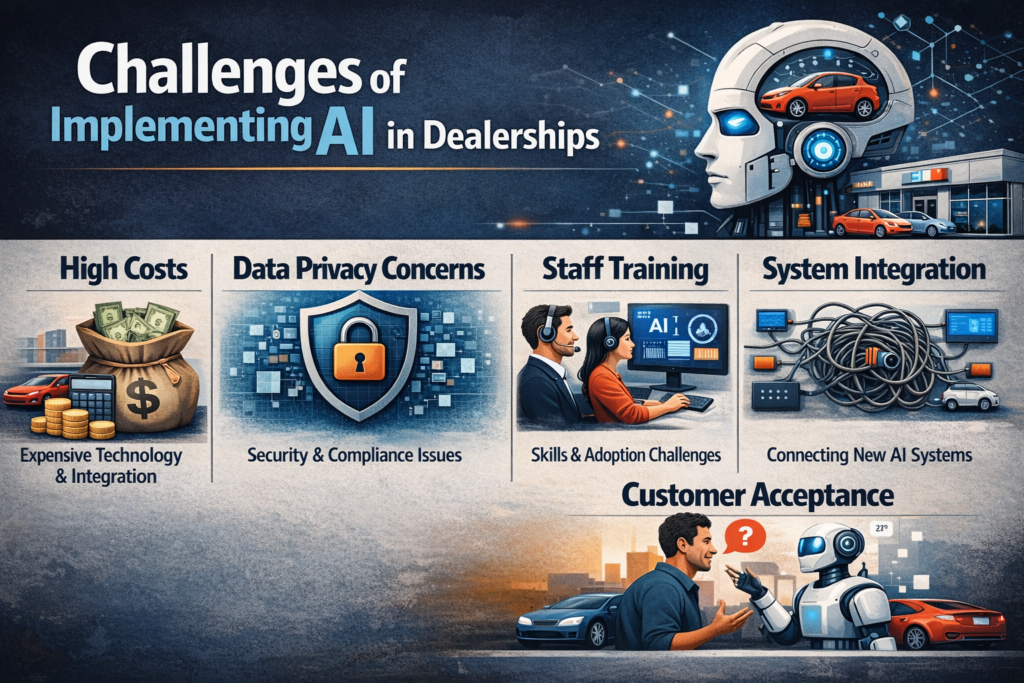
Despite the significant advantages, adopting AI solutions requires thoughtful planning and execution.
Common Implementation Challenges
Integrating data from multiple systems
Training staff to adapt to new technologies
Managing initial setup costs
Ensuring data privacy and security compliance
However, when implemented strategically, the long-term return on investment outweighs these short-term challenges. Automation reduces operational costs, improves efficiency, and enhances revenue growth over time.
The Future of AI in Automotive Dealerships
The future of AI in automotive is rapidly expanding. Emerging innovations such as generative AI, predictive analytics, and intelligent voice assistants are redefining dealership operations.
In the coming years, dealerships may use AI to:
Deliver fully digital car buying experiences
Offer AI-driven negotiation assistance
Predict regional market demand months in advance
Create hyper-personalized customer journeys
Automate end-to-end sales and service workflows
As competition intensifies, dealerships that embrace machine learning for dealerships and advanced automotive CRM AI platforms will gain a substantial competitive edge.
Why Dealerships Must Embrace AI Now
The automotive industry is undergoing a major digital transformation. Modern buyers demand convenience, personalization, and efficiency.
Dealerships that delay AI adoption risk:
Losing prospects to tech-enabled competitors
Reduced customer engagement
Inefficient marketing investments
Higher operational expenses
On the other hand, dealerships implementing AI tools experience:
Increased lead conversion rates
Stronger customer retention
Streamlined operations
Higher profitability
AI is no longer an optional upgrade-it is a strategic necessity for sustainable growth in the automotive sector.
Conclusion
Artificial intelligence and machine learning are fundamentally transforming the automotive dealership landscape. From intelligent lead scoring and personalized marketing to predictive maintenance and smart inventory management, AI in automotive is driving efficiency and growth.
By implementing machine learning for dealerships and leveraging automotive CRM AI, dealerships can create seamless customer journeys, optimize operations, and maximize profits.
The future of car sales is data-driven, automated, and customer-centric. Dealerships that embrace AI today will lead the automotive market tomorrow.